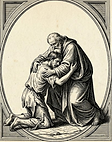
Part 4: Into the Hands of God by J.E. Rose
A Devotional Study of Matthew 18:29-35
“So his fellow servant fell down at his feet and begged him, saying, ‘Have patience with me, and I will repay you!’ 30 He would not, but went and cast him into prison until he should pay back that which was due. 31 So when his fellow servants saw what was done, they were exceedingly sorry, and came and told their lord all that was done. 32 Then his lord called him in and said to him, ‘You wicked servant! I forgave you all that debt because you begged me.33 Shouldn’t you also have had mercy on your fellow servant, even as I had mercy on you?’34 His lord was angry, and delivered him to the tormentors until he should pay all that was due to him.35 So my heavenly Father will also do to you, if you don’t each forgive your brother from your hearts for his misdeeds.” (Matthew 18:29-35)
I
t is difficult to understand this part of Jesus’ parable from our modern, western mindset. For us, prisons themselves are considered to be the punishment. In the ancient world, worse than the jail was the jailer! Jesus called the jailers “tormentors.” They were legally permitted to use any means necessary to extract payment of debt. Prisoners had no legal rights as in our day. Whether they had food not provided by a family member or friend was uncertain.
Prisoners could not repay debt in prison. So, when the parable describes the torture and torment to pay the debts, it wasn’t because the prisoner could pay them on some work-release program. His only hope was someone from outside coming to his aid. But with a debt of one thousand talents, only a king had that kind of money! And the servant had definitely burned that bridge
Justice and Revenge
When God made us in his image that included an innate sense of justice and morality; an unavoidable awareness of right and wrong. Obviously, this doesn’t mean we practice it. However, we are particularly aware of it when others offend us. When we are treated unjustly we cannot just ignore it or forget it. This is why we must look beyond “forgive and forget” to understand the biblical instruction.
Let’s remember the definition we have been using:
Forgiveness: the process of releasing those who have wronged us from threats of future revenge into the hands of God
God does not expect us to ignore injustices. He does not expect us to pretend they did not happen or excuse wrongdoing. As we’ve learned, forgiveness means we release them from threats of future revenge, but the rest says, “into the hands of God.” It is wrong for us to harbor bitterness in our hearts toward someone and to secretly (or openly) plot revenge. It is not wrong, however, to put them in God’s hands with assurance that he will have the final word.
In the last lesson we considered Paul’s instructions about those who wrong us, 9 Don’t seek revenge yourselves, beloved, but give place to God’s wrath. For it is written, “Vengeance belongs to me; I will repay, says the Lord.” (Romans 12:18,19).
Though the king in Jesus’ story was merciful and compassionate, he was nonetheless just. Elsewhere in Romans Paul said that God is the only one who has all the facts. Therefore, he alone can righteously judge others (Romans 2:2). We certainly do not have the moral standing to do so. Even when we have been wronged, God alone is able to mete out justice.
So, while we must not seek revenge for the sins of others we can and must trust that God will.
If there was ever a man who was victimized by injustice it was Jesus. Yet even Jesus refused to become bitter and seek revenge on his enemies. When he looked down from the cross at his accusers he said, “Father forgive them…”
Peter used Jesus’ example for enduring offenses and injustices of others without seeking revenge:
or what glory is it if, when you sin, you patiently endure beating? But if when you do well, you patiently endure suffering, this is commendable with God. 21 For you were called to this, because Christ also suffered for us, leaving you[b] an example, that you should follow his steps, 22 who didn’t sin, “neither was deceit found in his mouth.”23 When he was cursed, he didn’t curse back. When he suffered, he didn’t threaten, but committed himself to him who judges righteously. (1 Peter 2:20-23).
Study Guide
For us, ________________________themselves are considered to be the ________________________. In the ancient world, worse than the ___________________
was the ________________________!
When God _____________________ us _______________ _____________ ____________that included an ________________________ sense of __________________ and _____________________
It is wrong for us to ______________________ ________________________ in our hearts toward someone and to _____________________- (_______ _________________)secretly (or plot revenge. It is not wrong, however, to _______________ ___________________ in ________________ _________________
Reflection Questions
How does it affect you to think that God does not trust you to judge the sins of others enough to determine the just response?
Think about past and present crimes and conflicting relationships. Can you truthfully describe if there are some you have been unable or unwilling to forgive? What are you going to do about it?
Reflect on a significant example of injustice against you. Write a brief prayer or other description of how you could commit to ‘putting it in the hands of God.”