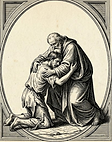
Part 3: Forgiveness, Reconciliation and Trust
A Devotional Study of Matthew 18:25-28
But because he couldn’t pay, his lord commanded him to be sold, with his wife, his children, and all that he had, and payment to be made. 26 The servant therefore fell down and knelt before him, saying, ‘Lord, have patience with me, and I will repay you all!’27 The lord of that servant, being moved with compassion, released him and forgave him the debt. 28 “But that servant went out and found one of his fellow servants who owed him one hundred denarii, and he grabbed him and took him by the throat, saying, ‘Pay me what you owe!’ (Matthew 18:25-28)
In Jesus’ story, the king was moved with compassion by the desperate plea of the servant who had no way to settle his extraordinary debt. But careful reading of the parable suggests that the focus of Jesus’ story was not the king as much as on the forgiven debtor. Even though he was forgiven a massive debt (one thousand talents), he refused to forgive the debt of one who owed him a hundred. It is likely this was especially meant for the self-righteous religious leaders to whom so much of Jesus’ ministry was directed. For us, it underscores the importance of rebuilding a broken relationship. We can picture a broken relationship as one of those old wooden foot bridges with so many broken planks it is dangerous to cross. One of the deeper reasons we refuse to forgive others is suspicion and mistrust if we try.
Rebuilding the Trust Bridge in Relationships
We find it most difficult to forgive people in the most important relationships: a child of an abusive parent; a spouse of an unfaithful husband; an offended friend after malicious gossip. This is because at one time we trusted them but when the offense occurred the “trust bridge” that enabled us to have a relationship was broken. In Jesus’ parable, the king had trusted his servant enough to loan him all that money! We aren’t told what happened. But when the king decided to settle his account, the trust had been broken.
This broken trust helps us understand why forgiveness is so hard. It also explains why after the breach has occurred, even if both parties want to rebuild it, it can take so long to do so. Each of the broken “planks” in the relationship must be replaced. That doesn’t happen quickly. Sometimes one is ready to rebuild trust and the other is not. How are the biblical instructions supposed to work in this kind of uncertainty? What if we ask someone to forgive us but they refuse? Are we doomed to bitterness?
Forgiveness does not mean that the offense did not occur. Forgiveness does not even mean there will be no consequences. Finally, just because one person extends forgiveness does not guarantee the other will reciprocate. This was evident in the parable.
This reality of broken trust in relationships cannot excuse us from our own responsibility to forgive, however. It is evident in the practical instruction from Paul to Christians:
14 Bless those who persecute you; bless, and don’t curse. 15 Rejoice with those who rejoice. Weep with those who weep. 16 Be of the same mind one toward another. Don’t set your mind on high things, but associate with the humble. Don’t be wise in your own conceits. 17 Repay no one evil for evil. Respect what is honorable in the sight of all men. 18 If it is possible, as much as it is up to you, be at peace with all men. 19 Don’t seek revenge yourselves, beloved, but give place to God’s wrath. For it is written, “Vengeance belongs to me; I will repay, says the Lord.” 20 Therefore ““If your enemy is hungry, feed him. If he is thirsty, give him a drink; for in doing so, you will heap coals of fire on his head.” (Romans 12:14-20)
Notice the injustice and inequity in the relationship: “bless those who persecute you…” When Paul said to “repay no one evil for evil” he was giving a functional command to forgive them. However, notice what came next: “18 If it is possible, as much as it is up to you, be at peace with all men.” It may not be possible to rebuild the trust bridge in all broken relationships. However, the instruction remains: “Don’t seek revenge.”
Even if our request for forgiveness is rejected by others we are still commanded to give it. In fact, we are called to keep trying: Therefore ““If your enemy is hungry, feed him. If he is thirsty, give him a drink;
Study Guide
Careful reading of the parable suggests that the _______________________ of Jesus’ story was not the ____________________ as much as on the _____________ _______________.
We can picture a broken relationship as one of those _____________ _________________ ________________ ________________with so many ____________________ ______________it is _____________________ to cross.
We find it _______________________ _________________________ to _________________ people in the _____________________ _______________________ ___________________:
Reflection Questions
Consider an important relationship in your past or present that has broken. How has forgiveness and rebuilding been made more difficult because of the broken trust between you?
Paul said “if it is possible, leave peacefully…” Describe a broken relationship in your life that seems impossible to restore.
Think of a person with whom you have significant conflict right now. Even though you may not admit they are “enemies” in the sense Paul said in Romans 12, what are some ways God may be calling you to “feed” them in their “hunger” or give them “drink” in their thirst?