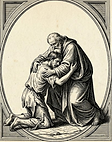
Part 1: The Forgiveness Process by J.E. Rose
A Devotional Study of Matthew 18:21,22
Forgiveness: the process of releasing those who have wronged us from threats of future revenge into the hands of God
18;21 Then Peter came and said to him, “Lord, how often shall my brother sin against me, and I forgive him? Until seven times?” 22 Jesus said to him, “I don’t tell you until seven times, but, until seventy times seven.23 (Matthew 18:21,22)
Since the first family conflict, Cain and Abel (Genesis 4:1ff), restoring a broken relationship has been one of the most difficult things we must do. It is no coincidence that in the biblical story, the seventh grandson of Cain was a man named Lamech, described as a vengeful tyrant who, after killing a young man proudly pronounced God’s judgment on himself, If Cain will be avenged seven times, truly Lamech seventy-seven times.” (4:24). In his strange proclamation, Lamech established a pattern in relationships we still deal with today. When we believe someone has wronged us, we resist any request to forgive them. Lamech used the phrase, “seventy-seven” to display the bitterness in his heart. Many Bible teachers believe it was this phrase Jesus referenced when Peter asked him about the limits of forgiveness, “how often shall I forgive…” Peter was looking for legal loopholes. Jesus was plugging them up.
But what is forgiveness?
In Jesus’ day, the Greek word for “forgiveness” consisted of two roots: APO (away) and HIEMI (send). In the ancient world, it was used in various contexts to describe “releasing”--like a crowd being dispersed from a public meeting or a slave being freed from his bondage and sent on his way.
Though this basic concept was undisputed, where Peter and others were confused was what it meant to release others. Like generations of rabbis before him, Peter was trying to redefine it to make it easier. His legalistic formula of releasing seven times may sound noble but in fact it was a formula for revenge: once the seventh offence occurred, there were no holds barred!
Today, we have our own legalistic formulas to avoid the hard work of reconciliation. We don’t describe it mathematically. But we have developed other ways to keep the desire for revenge. We must therefore begin defining what forgiveness is by first exposing what it is not:
Forgiveness is NOT a Feeling
One of the biggest misunderstandings about forgiveness is that it describes feelings we have toward someone. We also imagine that if we feel forgiveness we can offer it to someone. This error alone accounts for a vast majority of our lack of and unwillingness to forgive others.
Forgiveness is NOT Magic Words
from childhood we are told to “say you’re sorry” to mend broken relationships. Words are an important start but not enough. Repeating the magic words means we don’t have to release them from threats of future revenge.
Forgiveness is NOT Forgetting What Happened
we've all heard the phrase, “forgive and forget’, as if the two go hand-in-hand. There may be a certain role for forgetting but it is not the same as forgiveness. When forgetting is defined as forgiving, issues of injustice and penalties for true wrongdoing become confused.
Forgiveness is NOT a Single Event
Viewing forgiveness as a one-and-done event is in many ways an excuse for unforgiveness. It is very unlikely restoration and reconciliation can be accomplished in a single event. Usually, conflict in relationships develops over time. Why would we imagine that a relationship that has become damaged over days, months or even years could be suddenly restored in a single event? This is why we must define forgiveness not as a single event but the ongoing process of putting back together what was broken.
Jesus knew the history of human unforgiveness. We can appreciate the story he told as his way of defining forgiveness and reconciliation the way God wants us to.
Study Guide
“In his strange proclamation, _______________________ established a pattern in _________________ we still deal with today”
In Jesus’ day, the Greek word for “________________________” consisted of two roots: _____________(away) and _______________________(send). In the ancient world, it was used in various contexts to describe “_______________________________”-
Today, we have our own ____________________________ _____________________ to avoid the hard work of ___________________________________. We don’t describe it __________________________. But we have developed other ways to hold on to the __________________for __________________.
Reflection Questions
Think about a significant relational conflict in your life. How have you been inclined to view forgiveness in these ways instead of what Jesus described and how do these hinder the long term process of relational reconciliation/
A Feeling
Magic Words
Forgetting What Happened
A Single Event