Redeeming Labor (Day) by J.E. Rose

A Reflection on Ephesians 5:15-17
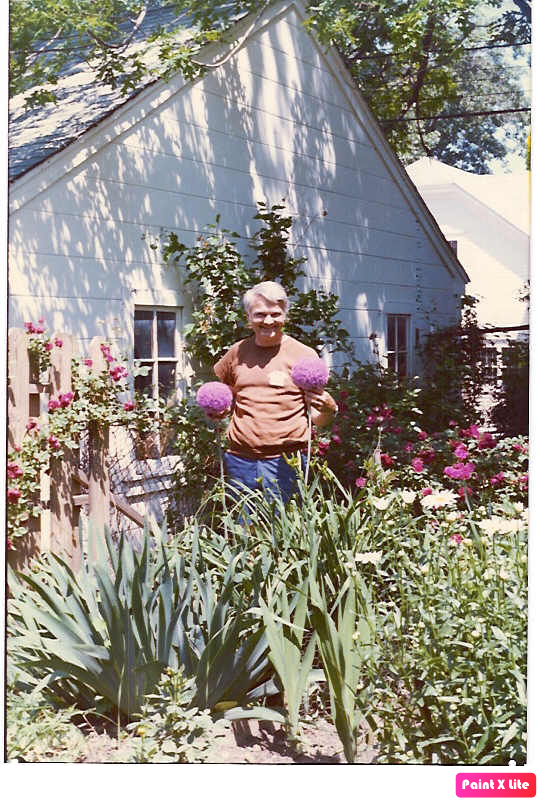
My dad (as his dad before him) loved gardening. This picture from around 1975 shows him in his element in a massive flower garden he toiled to create in our backyard. Notice I said, “toiled.” I used that word intentionally because though it was a labor of love it was still labor. He is now in the Heavenly Garden so I can’t ask him, but I know the cultivation and maintenance of that backyard garden took years.
I’ve been thinking about work this Labor Day. One of my grandchildren asked, “what do we celebrate on Labor Day?” and I was struck by the power of that question. Most people don’t know that the first Labor Day celebration on a national scale was in 1894, specifically as a way to champion organized labor unions. I’m not going to spend time discussing the history of labor unions other than to emphasize the difference between celebrating work compared to celebrating the unions of workers. Whether unions are a good idea is not my purpose either. But I do want to state, categorically, that work itself is good and something to be celebrated on Labor Day. That’s because work was not some mere evolutionary development or a necessary evil that we should figure out how to avoid. Work is good because God invented it. But, as the little story of Dad’s garden reveals, to say work is a gift from God doesn’t mean it’s easy. And if we’re going to accurately celebrate Labor Day it will mean redeeming work, even as the Apostle Paul said about time:
Therefore watch carefully how you walk, not as unwise, but as wise, redeeming the time, because the days are evil. Therefore, don’t be foolish, but understand what the will of the Lord is (Ephesians 5:15-17)
Here are three things we must know and practice if we want to redeem work itself and have a better way to celebrate Labor Day:
A Brief History of Labor
Most secular histories of work would begin with some prehistoric ancestors scavenging for food to survive. The Biblical account could not be more different. Even before sin entered the world, God gave our first parents work to do:
Yahweh God took the man, and put him into the garden of Eden to cultivate and keep it. Yahweh God commanded the man, saying, “You may freely eat of every tree of the garden (Genesis 2:15,16)
Theologians sometimes describe this as the “covenant of creation” (or covenant of works) God made with Adam. I won’t dig into the theology of that concept here other than to state that God gave work as a good thing and labor was one of the ways Adam would reflect the uniqueness of the creatures made in his image (Genesis 1:26,27). In its original design, work was therefore to be a satisfying and useful “vocation.” Work would make Adam feel good! It would provide food. And, most important of all, it would be a way for him to be like his creator: God too works.
This idyllic picture didn’t last long. God had warned them not to eat from one particular tree–the Tree of the Knowledge of Good and Evil. That was part of the covenant agreement as well. And, the rest of the Bible tells what happened when Adam disobeyed God, breaking the covenant of works. In consequence, not only did Adam bring death to God’s good creation, and death on all his descendants (Romans 5:12). Adam also began experiencing the corruption of labor itself.
To Adam he said, “Because you have listened to your wife’s voice, and have eaten from the tree, about which I commanded you, saying, ‘You shall not eat of it,’ the ground is cursed for your sake. You will eat from it with much labor all the days of your life.
It will yield thorns and thistles to you; and you will eat the herb of the field.
You will eat bread by the sweat of your face until you return to the ground, for you were taken out of it. For you are dust, and you shall return to dust.” (Genesis 3:17-19)
Throughout history since, work has been both a blessing and a curse. Our labor is good insofar as it provides for our needs (and wants) and, on a larger scale, builds communities and nations. But work is also the source of much pain and heartache. We lose because of it. We get injured. Some people “work themselves to death.”
The first thing we must do if we would redeem Labor Day is have a correct understanding of this history. As with most holidays, we must come up with creative and memorable ways to pass this understanding from one generation to the next. Children and grandchildren need to know the story of work and what went wrong and that will provide the necessary foundation for us to celebrate and redeem it.
The Purpose of Labor
Therefore watch carefully how you walk, not as unwise, but as wise, redeeming the time, because the days are evil. Therefore, don’t be foolish, but understand what the will of the Lord is (Ephesians 5:15-17)
Paul’s command is more than a call to better time management. He wants us to see the moments “now” in the larger perspective of “eternity.” To “redeem the time” can literally mean to rescue every moment of life (including our jobs) from an empty, even hostile purpose. That’s why he says, “because the days are evil.” Elsewhere Paul characterizes it as “this present evil age” (Gal. 1:4; Eph. 2:2).
Our daily work is one vital arena where we save the time. Redeeming our labor is not simply a commercial transaction where we trade mundane hours for some eternal reward. Rather, it is the process whereby God sanctifies (makes holy) every detail in every minute of life–from great to small–for his glorious purpose. Thus, when Adam was slaving and sweating away in his garden east of Eden, he could nonetheless “redeem the time.” But this required that he understood God’s grand purpose for the work itself. What could he have understood that would help him redeem the drudgery?
For one thing, he would know he needed to sweat so he could feed his family. But beyond that, he would also remember what got him in this predicament to begin with–his disobedience–and that would humble his heart and give thanks for God’s forgiveness. But, ultimately I think it would make him think forward to the time when God would fulfill his promise to “crush the head of the serpent” (Genesis 3:15) and how that would usher in a new paradise–what we now call the new heaven and earth. All these thoughts would help him
The Enduring Value of Labor
For all the reasons I’ve discussed we should celebrate Labor Day each year and explain why God is pleased when we do. Work is a gift from God. It is no coincidence that the first “Labor Day” was the seventh day of creation: the sabbath. For six days God labored to make the world and everything in it. And, scripture says, on the seventh he stood back from all he had done and pronounced it good. To celebrate the accomplishment, he “rested” (Genesis 1;31).
I find it particularly tragic that the gift of sabbath has, throughout history to the present day, provoked more conflict than celebration. Many of us grew up in homes and churches where the sabbath meant a long list of dos and don’ts. Though it was called a “day of rest” that actually meant a “day of prohibitions.” There are historical reasons why that is the case we won’t rehearse here. However, it is ironic how similar this is to what Jesus confronted in his day 2000 years ago when he reminded his followers, “the sabbath was made for man not man for the sabbath” (Mark 2:27). Sabbath was a gift from God to spend one day in seven celebrating work itself. I believe there are three practical ways we should practice sabbath in our weekly routines teaching and modeling these for others as well. Think of them as three ways to “look” at work:
Looking Back - As I described above, we need to consider the history of work itself and celebrate the origins. This is true on Labor Day but also appropriate on the sabbath. Viewing work in this historical context–from the beginning of creation to now–can help us see its importance even in the midst of its toil.
Looking Around - We also considered the purpose of work and as we look around us at what work has accomplished it should prompt a grateful response of celebration: look at all God has given us; look at all the fruit of our labor! We should always be grateful for God’s gifts. Every time we eat we should give thanks for the food. Whenever we go to the bank to make a deposit we should rejoice in the paycheck. Even when we pay our bills we should be grateful that God supplied the money so we can. But I would urge us to make this even more explicit on Labor Day and the sabbath. As we share our Labor Day picnics each year and sit down at our Sunday Dinners each week, make it a time to “look around” with thankfulness for all God has done.
Looking Forward - The first sabbath in history was when God not only ceased from his creation work but also set apart the seventh day to look forward. What religious folks have most often failed to understand about the sabbath is what they most often neglect to see about labor itself. It was always a signpost pointing to the consummation of all things in the new heaven and new earth.
In The Great Divorce, C.S. Lewis envisions a painter arriving in the foothills of heaven, distressed that his art might no longer be needed where everyone already sees ultimate reality face-to-face.
A heavenly spirit reassures him: you will paint again, but with an entirely liberated soul. On earth, your craft was tangled with your ego, reputation, and the relentless urge to capture fleeting glimpses of a country far away. Here in heaven, you will paint out of uncorrupted joy—pure delight in beauty itself and the Beautiful One who made it.
That shift changes how I think of my dad. Even as I picture him standing in his backyard garden on earth, his tired fingernails stained with soil, I also wonder what he cultivates now in the presence of God. If Lewis is right, the afterlife for him is not idle. Perhaps he is now more a gardener than ever in this life. But it is so much better for him. His toil is stripped of its futility, exhaustion and decay. There are no aphids on the rose bushes, no weeds fighting for life in the dirt—only the effortless, joyful work of tending paradise simply out of love for the Garden’s Creator and for the love of watching the flowers bloom.

Comments